
Industrial IoT Hardware Technologies for AIoT-Enabled Specialty Chemical Manufacturing
AI and IoT Hardware for Specialty Chemical Identification, Workforce Visibility, Hazardous Material Control, Asset Tracking, Inventory Optimization, Batch Genealogy, and Regulatory Traceability.
Building Specialty Chemical Manufacturing on Trusted Digital Identification
Successful specialty chemical manufacturing begins with trustworthy identification. Every raw material, catalyst, pigment, additive, polymer resin, surfactant, solvent, laboratory sample, intermediate compound, production vessel, mixing tank, blending skid, chemical drum, IBC container, gas cylinder, pallet, mobile asset, and finished batch should possess a unique digital identity throughout its operational lifecycle.
AI and IoT solutions transform these identification events into actionable operational data. Industrial RFID readers automatically identify production assets at process checkpoints, BLE supports real-time indoor workforce and equipment visibility, barcode systems simplify standardized product identification, while rugged mobile computers enable operators to access production information directly from manufacturing areas.
These technologies collectively improve operational visibility without disrupting established production workflows.
Typical operational objectives include:
Improving workforce visibility across manufacturing facilities
Controlling access to hazardous processing areas and restricted laboratories
Identifying chemical containers throughout production and storage
Managing reusable drums, IBCs, totes, cylinders, and pallets
Improving raw material inventory accuracy
Supporting formulation work orders
Tracking intermediate compounds throughout batch production
Strengthening batch genealogy and electronic batch records
Improving laboratory sample identification
Enhancing warehouse inventory management
Simplifying hazardous material documentation
Supporting regulatory compliance and customer audits
Improving finished product shipment traceability
Reducing manual data collection throughout manufacturing operations
Rather than relying on manual recording or paper-based documentation, industrial identification hardware automatically captures operational events, allowing AI and IoT software to organize production information for engineering, quality, warehouse, maintenance, laboratory, and management teams.
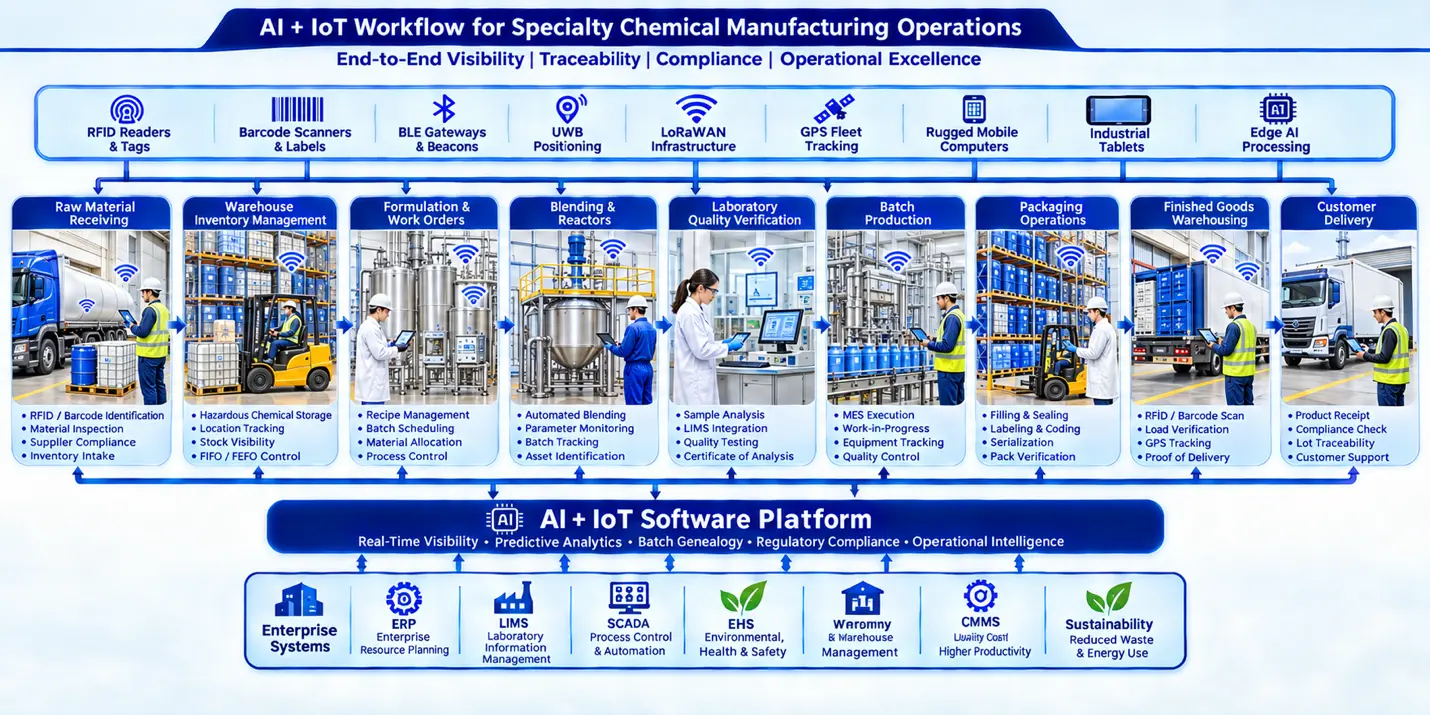
Industrial AIoT Hardware Architecture for Specialty Chemical Manufacturing: Enterprise Identification, Traceability & AI Integration
This enterprise AIoT solution diagram illustrates how industrial identification hardware connects every stage of specialty chemical manufacturing, from raw material receiving and hazardous chemical storage through formulation, laboratory testing, packaging, warehousing, and shipping. It shows RFID, barcode, BLE, handheld RFID readers, rugged mobile devices, industrial tablets, and wireless infrastructure integrating with AI + IoT software and enterprise systems—including ERP, MES, LIMS, QMS, WMS, CMMS, EHS, and SCADA—to deliver workforce visibility, hazardous material accountability, inventory optimization, electronic batch records, end-to-end batch genealogy, regulatory traceability, and shipment verification.
Why Industrial Identification Is Essential for Specialty Chemical Manufacturing
Specialty chemical manufacturers operate in environments where precision directly influences product quality, customer satisfaction, regulatory compliance, and production efficiency.
Every formulation may contain unique raw material combinations, processing conditions, mixing sequences, curing requirements, reaction pathways, packaging specifications, storage restrictions, and customer-specific acceptance criteria. Consequently, accurate identification becomes fundamental throughout manufacturing.
Industrial identification technologies support operations including:
Raw material receiving
Incoming material verification
Chemical warehouse management
Hazardous chemical storage
Batch formulation preparation
Production scheduling
Intermediate material movement
Laboratory sample identification
Quality assurance workflows
Packaging operations
Finished goods warehousing
Customer shipment verification
Product recall preparedness
Returnable container management
Reliable identification also improves electronic documentation, minimizes transcription errors, reduces manual reconciliation, and strengthens audit readiness for manufacturers operating under ISO quality systems, Responsible Care® initiatives, GMP-related environments where applicable, and customer-specific quality programs.
Core Industrial Identification Technologies Supporting Specialty Chemical Operations
Modern specialty chemical facilities rarely depend on a single identification technology. Instead, organizations deploy complementary identification solutions selected according to operational requirements, production workflows, facility layout, and environmental conditions.
Typical identification technologies include:
Industrial RFID identification systems
Bluetooth Low Energy (BLE) location
Ultra-Wideband (UWB) positioning
Industrial barcode identification
Fixed RFID portals
Handheld RFID readers
Rugged barcode scanners
Rugged mobile computers
Industrial tablets
Smart identification badges
Industrial smartphones
Private LTE communication
5G industrial connectivity
Cellular communication
LoRaWAN communication
Industrial Wi-Fi infrastructure
Each technology contributes unique operational capabilities. RFID excels at automated identification, BLE supports workforce visibility, UWB provides high-precision positioning, barcode technology delivers standardized identification, while rugged mobility devices connect personnel directly with enterprise software throughout production facilities. Selecting the appropriate combination allows manufacturers to optimize identification performance without introducing unnecessary operational complexity.
Supporting Workforce Visibility and Hazardous Area Access
Specialty chemical production facilities frequently contain blending rooms, reaction areas, laboratories, packaging operations, hazardous chemical storage locations, maintenance workshops, clean production areas, and restricted processing zones. Personnel routinely move between these operational areas while performing production, maintenance, quality assurance, engineering, laboratory, and logistics activities.
Industrial identification technologies improve workforce visibility without interrupting production activities. RFID-enabled employee credentials, BLE-enabled identification badges, secure access readers, and AI and IoT software help verify personnel authorization for hazardous processing areas while maintaining electronic records of facility access.
These records support contractor management, emergency response planning, workforce accountability, evacuation procedures, visitor management, and compliance documentation.
Engineering Experience Supporting Enterprise AIoT Deployments
SpecialtyChem AI was established within Aperture Venture Studio with support from GAO, building upon more than two decades of industrial IoT experience across thousands of successful deployments. Our engineering teams have supported organizations operating throughout the chemicals and pharmaceuticals industry by implementing industrial identification technologies that improve operational visibility, inventory management, regulatory compliance, and enterprise integration.
Continuous investment in research and development, comprehensive quality assurance processes, and experienced technical support allows organizations to deploy AI and IoT identification solutions with confidence. Our multidisciplinary team, led by Ph.D. professionals and supported by experienced industrial engineers, has contributed to projects involving Fortune 500 manufacturers, leading research institutions, universities, and U.S. and Canadian government agencies.
Chemical Identification Devices
Industrial identification devices provide the physical foundation for AI and IoT-enabled specialty chemical manufacturing. Every formulation ingredient, catalyst, pigment, resin, surfactant, process vessel, laboratory sample, chemical container, production asset, and finished product should possess a persistent digital identity that remains associated with the item throughout receiving, formulation, batch production, quality verification, packaging, warehousing, distribution, and customer delivery.
Chemical RFID Tags
Enables automated identification of chemical assets without direct line-of-sight scanning across drums, IBCs, totes, vessels, skids, and finished lots.
- Metal-mount tags for steel drums & reactors
- Chemical-resistant labels for plastic containers
- High-temperature & encapsulated tags
- Durable tags for outdoor tank storage
Chemical BLE Beacons
Provides continuous indoor visibility for personnel, mobile mixing carts, forklifts, calibration toolkits, and shared laboratory instruments in near real time.
- Workforce visibility & lone worker safety
- Equipment search & asset utilization analysis
- Emergency muster verification
- Facility occupancy & workflow optimization
Chemical Barcode Labels
Standardized, cost-effective 1D and 2D barcode identification across raw chemicals, QC samples, work orders, packaging materials, and shipping labels.
- Regulatory GHS labeling & customer specs
- Laboratory sample chain of custody
- Warehouse rack & bin location tags
- Complementary operation with RFID systems
Rugged Industrial Barcode Scanners
Engineered specifically for demanding specialty chemical environments with chemical-resistant housings, high-impact sealing, and long battery life.
- Dust & moisture sealed construction
- Glove-friendly ergonomic design
- High-speed wireless scanning
- Receiving, lab, and shipping validation
Industrial RFID Readers
Automatically collects identification data at receiving docks, warehouse portals, formulation staging skids, packaging lines, and shipping docks.
- Fixed portal & overhead reader arrays
- Dock door & conveyor readers
- Handheld & vehicle-mounted RFID units
- Dense container environment filtering
Chemical Mobile Computers
Brings enterprise software directly to operators with integrated RFID reading, barcode scanning, BLE, Wi-Fi, and digital work instructions.
- Batch documentation & work instructions
- Real-time inventory transactions
- Quality verification at point of work
- Eliminates desktop workstation travel
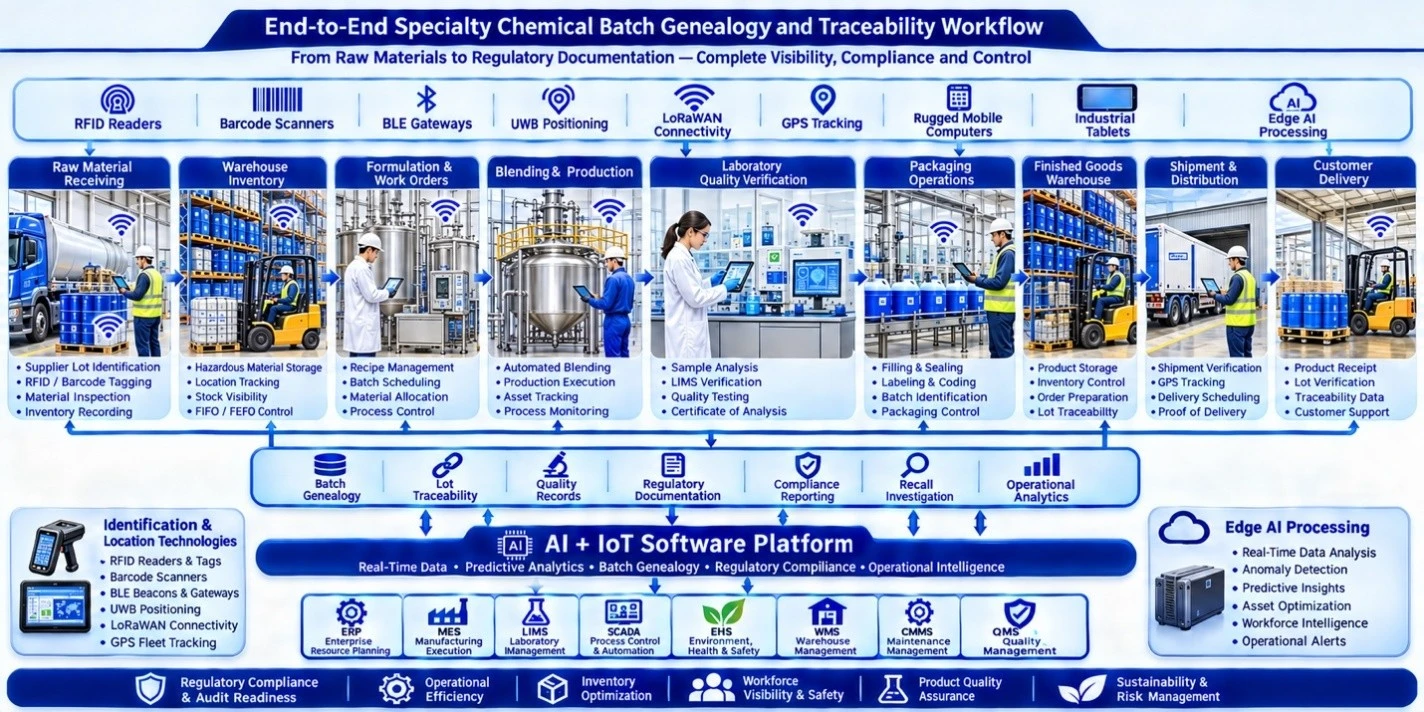
Enterprise Integration Block Diagram for AIoT-Enabled Specialty Chemical Manufacturing: Identification Hardware, Data Flow & Enterprise Software
This enterprise integration block diagram illustrates how industrial identification hardware captures and routes operational data throughout the specialty chemical manufacturing lifecycle, from receiving and hazardous material storage through formulation, laboratory testing, packaging, warehousing, shipping, and enterprise reporting. It demonstrates how RFID, barcode, BLE, UWB, rugged mobile devices, industrial networking, and AI + IoT software integrate with ERP, MES, LIMS, WMS, QMS, EHS, CMMS, SCADA, PLM, and TMS to enable end-to-end asset tracking, workforce visibility, inventory optimization, electronic batch records, batch genealogy, and regulatory traceability.
Chemical Location Technologies
Knowing what an asset is represents only one component of operational visibility. Knowing where that asset is located throughout production often provides equally important operational value across formulation, blending, and distribution.
AI and RFID Chemical Tracking
Automated checkpoint identification during material receiving, warehouse transfers, formulation issues, packaging confirmation, and shipping validation.
AI and BLE Chemical Tracking
Continuous indoor visibility for workforce safety, mobile equipment location, shared laboratory instruments, contractor tracking, and emergency mustering.
AI and UWB Chemical Tracking
Ultra-accurate indoor positioning for automated guided vehicles (AGVs), autonomous mobile robots (AMRs), high-value instruments, and critical reactors.
AI and GPS Chemical Tracking
Outdoor location awareness for chemical tanker fleets, bulk deliveries, finished product shipments, and interfacility transport tracking.
AI and Cellular Chemical Tracking
Continuous LTE and 5G connectivity for mobile assets, regional distribution, temporary storage yards, and cross-site logistics.
AI and LoRaWAN Chemical Tracking
Long-range, low-power communications across tank farms, bulk storage facilities, utility infrastructure, and outdoor distribution yards.
| Technology | Primary Strength | Typical Specialty Chemical Applications |
|---|---|---|
| RFID | Automated identification and traceability | Raw material containers, chemical drums, IBCs, mixing vessels, blending skids, production equipment, warehouse inventory, finished product pallets |
| BLE | Real-time indoor location visibility | Operator badges, laboratory instruments, mobile mixing equipment, forklifts, chemical handling carts, maintenance tools, safety-critical assets |
| Barcode | Standardized product and sample identification | Raw material labels, formulation work orders, laboratory samples, batch records, QC documentation, finished product labels, shipping documentation |
| UWB | High-precision real-time positioning | Automated guided vehicles (AGVs), autonomous mobile robots (AMRs), critical production assets, high-value laboratory equipment, hazardous material handling equipment |
| GPS | Outdoor asset and shipment tracking | Chemical tanker fleets, bulk chemical deliveries, finished product shipments, reusable transport containers, field service vehicles |
| Cellular (LTE/5G) | Secure wide-area connectivity | Remote storage facilities, mobile inspection teams, chemical transportation, fleet monitoring, distributed manufacturing sites |
| LoRaWAN | Long-range industrial IoT communication | Tank farms, bulk chemical storage yards, environmental monitoring, utility infrastructure, remote warehouses, outdoor production assets |
Chemical Container Identification
Chemical containers represent the physical link between raw materials, formulation processes, intermediate compounds, finished specialty chemicals, and downstream distribution. Accurate identification of every container throughout its lifecycle is essential for maintaining inventory integrity, batch genealogy, production efficiency, regulatory compliance, and product quality.
Chemical Drum Identification
Specialized metal and plastic RFID tags provide durable identification for raw material receiving, formulation allocation, batch staging, finished storage, and returnable drum tracking.
Chemical Tote Identification
Reusable chemical totes circulate continuously across production, blending, and QC. Digital identification prevents misplaced materials and tracks tote cleaning and inspection histories.
Chemical Pallet Identification
Creates digital visibility for finished specialty chemical pallets awaiting shipment during put-away, order picking, loading, and customer distribution verification.
Gas Cylinder Identification
Supports process and inerting gases used in laboratories and reaction skids, tracking storage location, usage history, maintenance, refill scheduling, and safety records.
Chemical Mobility Devices
Industrial mobility solutions extend AI and IoT capabilities directly to operators, lab technicians, and maintenance engineers.
Rugged Chemical Mobile Computers
Integrated RFID, barcode scanning, Wi-Fi, and digital work instructions bring enterprise applications directly to the shop floor.
Chemical Operations Tablets
Large displays for electronic batch records, digital formulation recipes, equipment maintenance drawings, and supervisory dashboards.
Chemical Smart ID Badges
Combines workforce identification, zone access authorization, emergency muster accountability, and safety compliance records.
Industrial Chemical Smartphones
Compact enterprise communication devices for maintenance engineers, quality inspectors, warehouse supervisors, and logistics staff.
Building a Connected Specialty Chemical Manufacturing Environment
Digital transformation within specialty chemical manufacturing begins with reliable identification. Every raw material, formulation ingredient, production asset, laboratory sample, chemical container, warehouse location, and finished batch should be associated with accurate identification data that supports operational decision-making throughout the manufacturing lifecycle.
Industrial RFID, BLE, UWB, barcode technologies, rugged mobility devices, and enterprise wireless communication establish the digital foundation required for AI and IoT software to improve workforce visibility, chemical asset management, inventory optimization, hazardous material handling, batch genealogy, warehouse efficiency, and regulatory traceability.
U.S. Standards and Regulations 33 Standards
Canadian Standards and Regulations 21 Standards
Industry Automatic Identification & Industrial Wireless Standards 24 Standards
Top Players in AI and IoT Identification and Location Solutions for Specialty Chemical Manufacturing
These recognized organizations support AI and IoT-enabled workforce visibility, access governance, chemical asset tracking, inventory optimization, batch genealogy, warehouse operations, and regulatory traceability.
Automatic Identification
Zebra Technologies, Honeywell, HID Global, Avery Dennison, SICK, Datalogic, Cognex, Impinj, Brady Corporation, Identiv, GAO RFID Inc., TSC Auto ID, CAEN RFID, FEIG Electronic, Balluff, Turck, Pepperl+Fuchs, Omni-ID, Xerafy, Confidex, Tageos, Beontag.
BLE, UWB & Location Technologies
Quuppa, Sewio Networks, Kontakt.io, Litum, HID Global RTLS, Siemens SIMATIC RTLS, Zebra MotionWorks, Ubisense, AiRISTA Flow, CenTrak, Kinexon, Eliko, WISER Systems, Inpixon, Pozyx.
Industrial Mobile Computers
Zebra Technologies, Honeywell, Datalogic, CipherLab, Bluebird, Unitech Electronics, Panasonic Toughbook, Getac, Advantech, Winmate, Trimble, Handheld Group, Janam Technologies.
Industrial Wireless Communication
Cisco, HPE Aruba, Siemens, Moxa, Belden, Phoenix Contact, HMS Networks, Ericsson, Nokia, Cradlepoint, Digi International, Sierra Wireless, Semtech, MultiTech, Rajant Corporation.
Industrial Automation & SCADA
Siemens, Rockwell Automation, Schneider Electric, Emerson, ABB, Yokogawa Electric, Honeywell Process Solutions, Mitsubishi Electric, Omron, Beckhoff Automation, Bosch Rexroth, WAGO, Endress+Hauser.
ERP & Manufacturing Systems
SAP, Oracle, Microsoft, IBM, AVEVA, AspenTech, Dassault Systèmes, PTC, Hexagon, Infor, Epicor, IFS, Körber Supply Chain, Blue Yonder, Manhattan Associates.
Laboratory & Quality Systems
Thermo Fisher Scientific, LabVantage Solutions, LabWare, STARLIMS, Siemens Opcenter Quality, Dassault Systèmes BIOVIA, Waters Corporation, Agilent Technologies, Abbott Informatics, Benchling.
AI, Edge & Cloud Infrastructure
NVIDIA, Intel, AMD, Dell Technologies, HPE, Lenovo, Supermicro, Advantech, OnLogic, IBM, Microsoft Azure, Google Cloud, AWS, Oracle Cloud.
Case Studies in Specialty Chemical Manufacturing
Explore real-world industrial deployments demonstrating measurable operational improvements across workforce visibility, asset management, batch traceability, and multi-site coordination.
Case Study 1
Houston, Texas, USA: Workforce Visibility & Hazardous Access Governance
View Details ↓
Primary AI & IoT Functions:
Specialty Chemical Workforce Visibility, Hazardous Area Access Governance, Chemical Operator Analytics, Contractor Authorization, Laboratory Personnel Visibility, Emergency Muster Management.
Technologies & GAO Hardware:
GAO RFID UHF Readers & Tags, GAO RFID BLE Beacons & Gateways, GAO Tek Rugged Mobile Computing, Edge Computing, Industrial Wi-Fi & Private LTE.
Background: A large facility producing performance additives and polymers sought to improve personnel accountability across hazardous zones that previously relied on manual logs.
Solution: SpecialtyChem AI implemented BLE-enabled smart ID badges, BLE Gateways throughout corridors and muster points, GAO RFID UHF Readers at hazardous doors, and rugged mobile computers with Edge Computing.
Result: Emergency muster was completed in under 5 minutes during drills, manual contractor checks were eliminated, and hazardous area entry records became automatically available for audit compliance.
Case Study 2
Baton Rouge, Louisiana, USA: Chemical Asset Tracking & Inventory Optimization
View Details ↓
Primary AI & IoT Functions:
Chemical Asset Tracking, Chemical Inventory Optimization, Chemical Drum Identification, IBC Container Visibility, Warehouse Inventory Management, Batch Material Verification, WIP Visibility.
Technologies & GAO Hardware:
GAO RFID UHF Readers & Tags, GAO RFID Antennas, GAO RFID BLE Products, GAO Tek Rugged Mobile Computers, Edge Computing.
Background: A formulation facility producing coatings and resins managed thousands of drums and IBCs with barcode scanning and spreadsheets, creating material search bottlenecks.
Solution: Installed GAO RFID UHF Tags on drums, IBCs, and pallets, positioned fixed readers at docks and staging portals, and integrated rugged handhelds with warehouse management software.
Result: Search times were reduced substantially, IBC utilization increased, inventory reconciliation cycles accelerated, and batch staging accuracy improved significantly.
Case Study 3
Newark, New Jersey, USA: Batch Traceability & Work-in-Progress Visibility
View Details ↓
Primary AI & IoT Functions:
Batch WIP Visibility, Chemical Batch Traceability, Lot Genealogy, Intermediate Compound Identification, Production Queue Visibility, Chemical Shipment Traceability.
Technologies & GAO Hardware:
GAO RFID UHF Readers, UHF Tags & Antennas, GAO RFID BLE Gateways, GAO Tek Rugged Mobile Computers, Edge Computing, Private LTE.
Background: An electronic chemicals and specialty coatings manufacturer required continuous visibility into batch progression across multiple buildings without manual paper logs.
Solution: Applied persistent RFID digital identities to batch containers, intermediate vessels, and pallets with automatic checkpoint recording at formulation, blending, QC, and packaging.
Result: Continuous WIP visibility, automated batch genealogy association, simplified quality audits, and rapid shipment readiness validation.
Case Study 4
Sarnia, Ontario, Canada: BLE Workforce Visibility & RFID Chemical Asset Tracking
View Details ↓
Primary AI & IoT Functions:
Workforce Visibility, Access Governance, Chemical Asset Tracking, Inventory Management, Laboratory Asset Identification, Chemical Drum Tracking, Hazardous Area Authorization.
Technologies & GAO Hardware:
GAO RFID BLE Beacons & Gateways, GAO RFID UHF Readers & Tags, GAO Tek Rugged Mobile Computers, Cellular IoT Devices, Edge Computing.
Background: A Canadian manufacturer producing specialty resins and treatment chemicals sought to modernize personnel accountability and mobile equipment tracking across multi-building campuses.
Solution: Combined BLE employee badges and gateways for indoor location awareness with UHF RFID tags for chemical drums, IBCs, and lab instruments.
Result: Real-time campus-wide workforce visibility, electronic contractor management, faster emergency muster, and optimized mobile asset utilization.
Get Started with SpecialtyChem AI
Whether you are modernizing batch manufacturing operations, improving hazardous chemical inventory management, enhancing warehouse visibility, implementing electronic batch records, or strengthening product traceability, SpecialtyChem AI can help you identify the most appropriate industrial identification technologies for your facility.
Contact our engineering team to discuss your specialty chemical manufacturing requirements and discover how RFID, BLE, UWB, barcode, rugged mobile computing, and industrial wireless communication can support your operational, quality, and compliance objectives.
Specialty Chemical Manufacturing for AI and IoT Identification and Location Solutions
AI and IoT-enabled identification and location solutions support virtually every stage of specialty chemical manufacturing, from raw material receiving through formulation, packaging, warehouse operations, and customer shipment. Unlike continuous process chemical production, specialty chemical operations often involve smaller production batches, recipe-driven manufacturing, multiple raw material variants, strict formulation control, hazardous material handling, extensive laboratory verification, and comprehensive regulatory documentation.
SpecialtyChem AI focuses on industrial identification and location technologies including RFID, BLE, UWB, barcode, GPS, LoRaWAN, rugged mobile computing, and industrial wireless communication that enable AI and IoT software to improve workforce visibility, access governance, chemical asset management, inventory accuracy, work-in-progress visibility, and end-to-end batch genealogy.