Specialty Chemical System Integration
Integrate AI and IoT Software with ERP, MES, LIMS, RFID, PLC, SCADA, Cloud, Hybrid, and Server Systems for Specialty Chemical Manufacturing Operations.
Connect Enterprise Systems Across Specialty Chemical Manufacturing Operations
Enterprise integration enables specialty chemical manufacturers to establish a connected operational environment where production, laboratory, warehouse, maintenance, quality assurance, logistics, and business systems exchange accurate information automatically. Rather than maintaining isolated software applications that require repetitive manual updates, integrated enterprise software synchronizes critical operational data across the manufacturing lifecycle.
Specialty chemical production is inherently more complex than conventional batch manufacturing. Every formulation may contain dozens of raw materials, specialty additives, catalysts, pigments, solvents, polymers, or proprietary compounds requiring controlled sequencing, precise weighing, validated mixing procedures, laboratory verification, packaging specifications, customer documentation, and regulatory records. Enterprise integration ensures these processes remain coordinated from raw material receiving through finished product shipment.
Modern specialty chemical facilities commonly operate multiple production lines simultaneously while manufacturing customer-specific formulations with varying production schedules and packaging requirements. Production planners, warehouse personnel, laboratory analysts, quality engineers, maintenance teams, logistics coordinators, and executive management all rely on synchronized operational information to support efficient manufacturing decisions.
SpecialtyChem AI integrates enterprise software without requiring manufacturers to replace existing business systems or production applications. Existing ERP software, Manufacturing Execution Systems (MES), Laboratory Information Management Systems (LIMS), warehouse software, Environmental Health and Safety (EHS) applications, maintenance systems, and industrial control software remain operational while securely exchanging information throughout the organization.
AI and IoT strengthens this connected environment by combining AI with industrial identification technologies rather than focusing primarily on monitoring devices. RFID identification, BLE asset identification, barcode technologies, Ultra-Wideband (UWB) location services, GPS fleet visibility, Cellular communications, and LoRaWAN connectivity associate personnel, production assets, chemical containers, intermediate compounds, finished lots, work orders, laboratory samples, and warehouse inventory with enterprise software. This identification-first strategy provides accurate operational visibility while supporting production efficiency, regulatory compliance, and enterprise reporting.
Integrated enterprise software also supports complete batch genealogy by associating every production stage with raw material consumption, intermediate processing, laboratory approvals, packaging operations, warehouse transactions, and shipment records. This capability simplifies customer documentation, product recalls, quality investigations, regulatory audits, and continuous process improvement initiatives.
For manufacturers producing hazardous chemicals, enterprise integration improves coordination between production planning, hazardous material storage, chemical compatibility management, controlled access procedures, packaging operations, transportation documentation, and customer delivery. Information remains consistent across departments while reducing administrative effort and minimizing opportunities for manual documentation errors.
Organizations operating multiple manufacturing facilities benefit from standardized enterprise software that supports centralized reporting while allowing each location to maintain site-specific production procedures. Cloud, hybrid, and on-premises deployment options provide flexibility for organizations with varying cybersecurity policies, regulatory requirements, and operational objectives.
SpecialtyChem AI develops enterprise software specifically for complex specialty chemical operations where formulation accuracy, production coordination, laboratory validation, warehouse management, and regulatory documentation must function together as a unified operational environment. This approach helps manufacturers improve operational efficiency while preserving existing investments in enterprise software and industrial automation.
Why Enterprise Integration Matters for Specialty Chemical Manufacturing
Enterprise integration is not simply an information technology initiative. It is a strategic manufacturing capability that supports formulation accuracy, operational consistency, product quality, regulatory compliance, hazardous material governance, inventory optimization, warehouse efficiency, and enterprise-wide decision making.
Specialty chemical manufacturers operate in an environment where every formulation, production batch, intermediate compound, laboratory result, packaging operation, warehouse transaction, and shipment record contributes to complete product genealogy. Accurate enterprise integration allows organizations to establish a reliable digital record throughout the entire manufacturing lifecycle while improving collaboration between engineering, operations, laboratory, quality assurance, maintenance, logistics, and executive management.
This integrated approach creates a scalable foundation for future digital manufacturing initiatives while enabling organizations to maximize the value of existing ERP, MES, LIMS, warehouse, maintenance, and industrial control software investments.
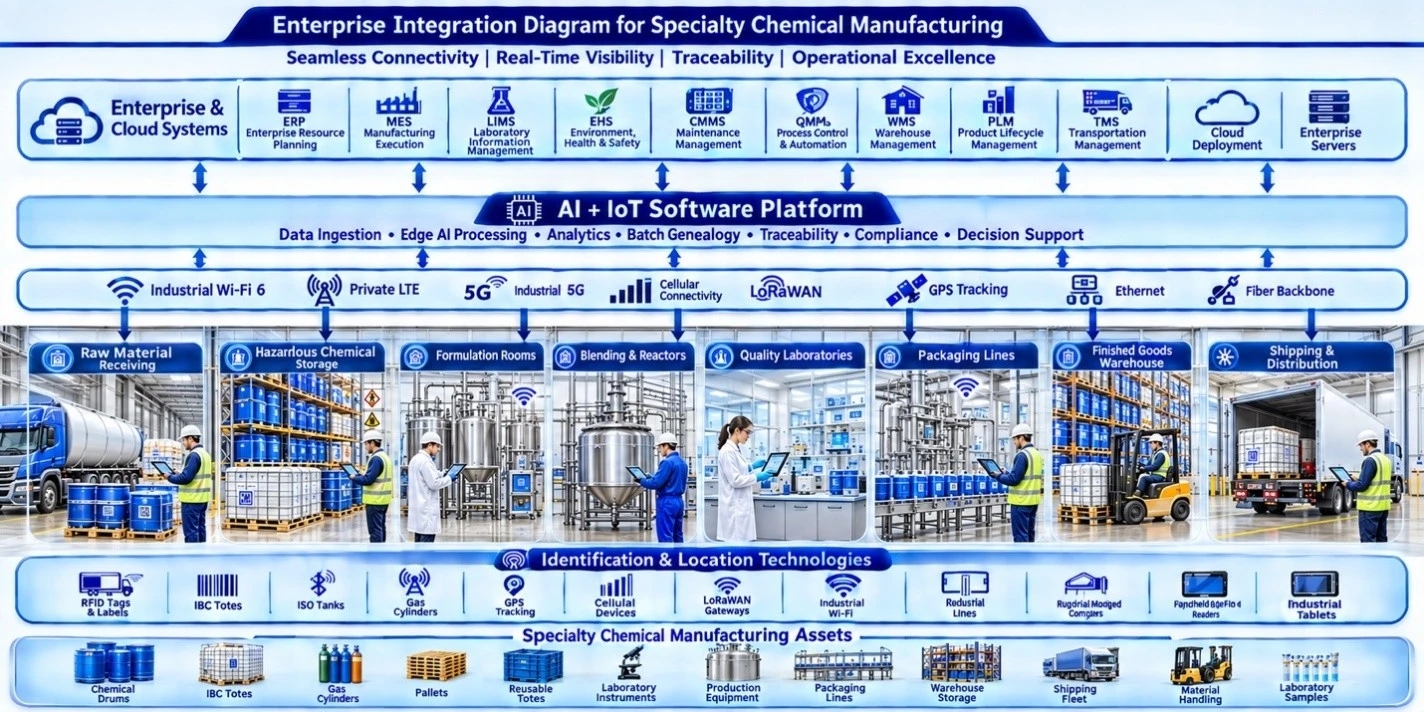
Enterprise System Integration Architecture for Specialty Chemical Manufacturing: AIoT, ERP, MES, LIMS & Operational Data Flow
This enterprise integration diagram illustrates how operational data flows across a specialty chemical manufacturing facility, connecting receiving, hazardous material storage, formulation, production, laboratory testing, packaging, warehousing, shipping, and executive reporting. It demonstrates how RFID, barcode, BLE, UWB, GPS, LoRaWAN, cellular communications, and AI + IoT software integrate with ERP, MES, LIMS, EHS, CMMS, SCADA, PLC, WMS, cloud infrastructure, and enterprise servers to deliver real-time visibility, batch genealogy, regulatory traceability, inventory optimization, and data-driven operational decision-making.
Chemical Business System Integration
Specialty chemical manufacturing depends on the continuous exchange of accurate information between business software, production operations, quality laboratories, warehouse management, maintenance teams, regulatory documentation, and executive reporting. Enterprise integration eliminates disconnected information silos by enabling business systems to securely exchange validated data throughout formulation development, raw material receiving, batch production, quality verification, packaging, inventory management, and customer fulfillment.
Unlike discrete manufacturing, specialty chemical production involves formulation-driven batch processes, controlled raw material dispensing, recipe version management, intermediate compound handling, hazardous material documentation, laboratory approvals, lot genealogy, Certificates of Analysis (CoA), Safety Data Sheets (SDS), GHS labeling, REACH documentation, customer-specific specifications, and product release procedures. These interconnected activities require enterprise software that operates as a coordinated system rather than isolated applications.
Specialty Chemical ERP Integration
Enterprise Resource Planning (ERP) manages procurement, inventory valuation, production scheduling, purchasing, finance, and customer orders across thousands of chemical SKUs.
- Synchronizes purchasing with formulation schedules
- Batch production planning & Material Requirements Planning (MRP)
- Warehouse inventory reconciliation & finished goods availability
- Real-time production costing and financial reconciliation
Batch Manufacturing MES Integration
Manufacturing Execution Systems coordinate work orders, batch instructions, formulation sequencing, operator workflows, and production performance reporting.
- Coordinates formulation execution & production sequencing
- Generates complete electronic batch records
- Real-time visibility into active formulation queues
- Strengthens manufacturing consistency & batch genealogy
Chemical Quality LIMS Integration
Laboratory Information Management Systems coordinate analytical testing, sample tracking, quality documentation, Certificates of Analysis, and product release.
- Automates sample workflow from shop floor to QC lab
- Electronic Certificates of Analysis (CoA) generation
- Supports batch release decisions & customer specs
- Reduces manual transcription & simplifies audit prep
Chemical EHS Integration
Environmental, Health, and Safety coordinates environmental compliance, workforce authorization, contractor management, hazardous documentation, and emergency response.
- Controlled hazardous chemical storage & zone access
- Emergency muster accountability & contractor qualifications
- OSHA PSM, GHS labeling, SDS, and REACH documentation
- Strengthens operational safety governance across facilities
Unified Enterprise Information Exchange
When ERP, MES, LIMS, and EHS software operate as an integrated enterprise environment, specialty chemical manufacturers gain a comprehensive operational view that extends from procurement through production, laboratory verification, warehousing, packaging, shipment, and customer delivery. Instead of relying on isolated spreadsheets, organizations establish standardized information exchange across all departments, providing the digital foundation for scalable AI and IoT initiatives.
Specialty Chemical Process Connectivity
Specialty chemical manufacturing requires reliable communication between enterprise software, production systems, warehouse operations, laboratory workflows, packaging lines, maintenance activities, and industrial control environments. Process connectivity ensures that production information moves securely and consistently throughout the manufacturing lifecycle.
Chemical RFID Data Integration
Captures real-time movement of raw material containers, IBCs, drums, totes, and finished pallets, automatically posting transaction events to ERP, MES, and WMS.
Batch PLC Integration
Connects mixing skids, dosing systems, reactors, and packaging machinery with MES software while preserving operational independence of validated industrial controllers.
Chemical SCADA Integration
Consolidates operational status across multi-building facilities, bridging real-time supervisory process visualization with executive dashboards and maintenance planning.
Formulation API Integration
Secure REST and industrial APIs provide seamless data exchange between laboratory software, production recipes, warehouse systems, and third-party logistics.
Chemical Batch Edge Computing
Batch-oriented specialty chemical manufacturing often requires operational decisions to be made locally within production facilities, even when external enterprise communication is temporarily unavailable. Edge computing addresses this requirement by processing operational information close to manufacturing activities while maintaining synchronization with centralized enterprise software.
Edge AI Batch Processing
Local intelligence evaluates batch progression, detects queue delays, optimizes work order sequencing, and verifies material allocation with sub-second response times.
Local Formulation Processing
Ensures work orders, approved recipe revisions, and packaging specifications remain accessible on shop-floor devices even during network interruptions.
Batch Release Decision Support
Consolidates electronic batch records, QC test approvals, and packaging logs locally to accelerate quality review and lot disposition.
Offline Batch Synchronization
Automatically queues and securely reconciles all local transactions with enterprise ERP and MES servers the moment external communication is restored.
Specialty Chemical Deployment Options
Selecting the appropriate deployment strategy is a critical architectural decision. SpecialtyChem AI supports cloud, on-premises server, hybrid, and multi-site deployment models designed to meet unique operational, cybersecurity, and regulatory requirements.
Cloud Chemical Operations
Centralizes enterprise software management for organizations operating multiple production plants, research labs, and regional distribution warehouses with consolidated global reporting.
Server Chemical Deployment
Dedicated on-premises servers provide maximum cybersecurity control, protect proprietary chemical formulation databases, and ensure 24/7 standalone operational continuity.
Hybrid Chemical Deployment
Balances local plant execution resilience with centralized corporate cloud reporting, business analytics, and multi-site inventory visibility.
Multi-Site Chemical Deployment
Standardizes quality systems, regulatory procedures, and operational governance across global manufacturing facilities while preserving local plant flexibility.
Why SpecialtyChem AI
SpecialtyChem AI was created within Aperture Venture Studio, with support from GAO, leveraging more than two decades of industrial IoT expertise developed through thousands of successful enterprise deployments across manufacturing industries.
Led by Ph.D. professionals from leading universities and supported by multidisciplinary engineering teams, we specialize in enterprise software integration, industrial identification technologies, AI and IoT software, warehouse optimization, LIMS, MES, and regulatory compliance for Fortune 500 manufacturers and global chemical enterprises.
Ready to Modernize Your Specialty Chemical Manufacturing Operations?
Contact SpecialtyChem AI to discuss your specialty chemical manufacturing environment, evaluate your current enterprise systems, and develop a practical integration roadmap tailored to your production operations.
Our engineering team helps you design scalable identification and system integration architectures connecting ERP, MES, LIMS, EHS, SCADA, PLC, RFID, and cloud infrastructure for end-to-end operational excellence.